
Description
Endemic to the Seychelles. Natural stands of the Coco-de-mer are only found on the islands of Praslin and Curieuse, in the Seychelles. It is extinct on St Pierre, Chauve-Souris and Round Islands. Planted subpopulations occur on Mahé and Silhouette Islands.
Description
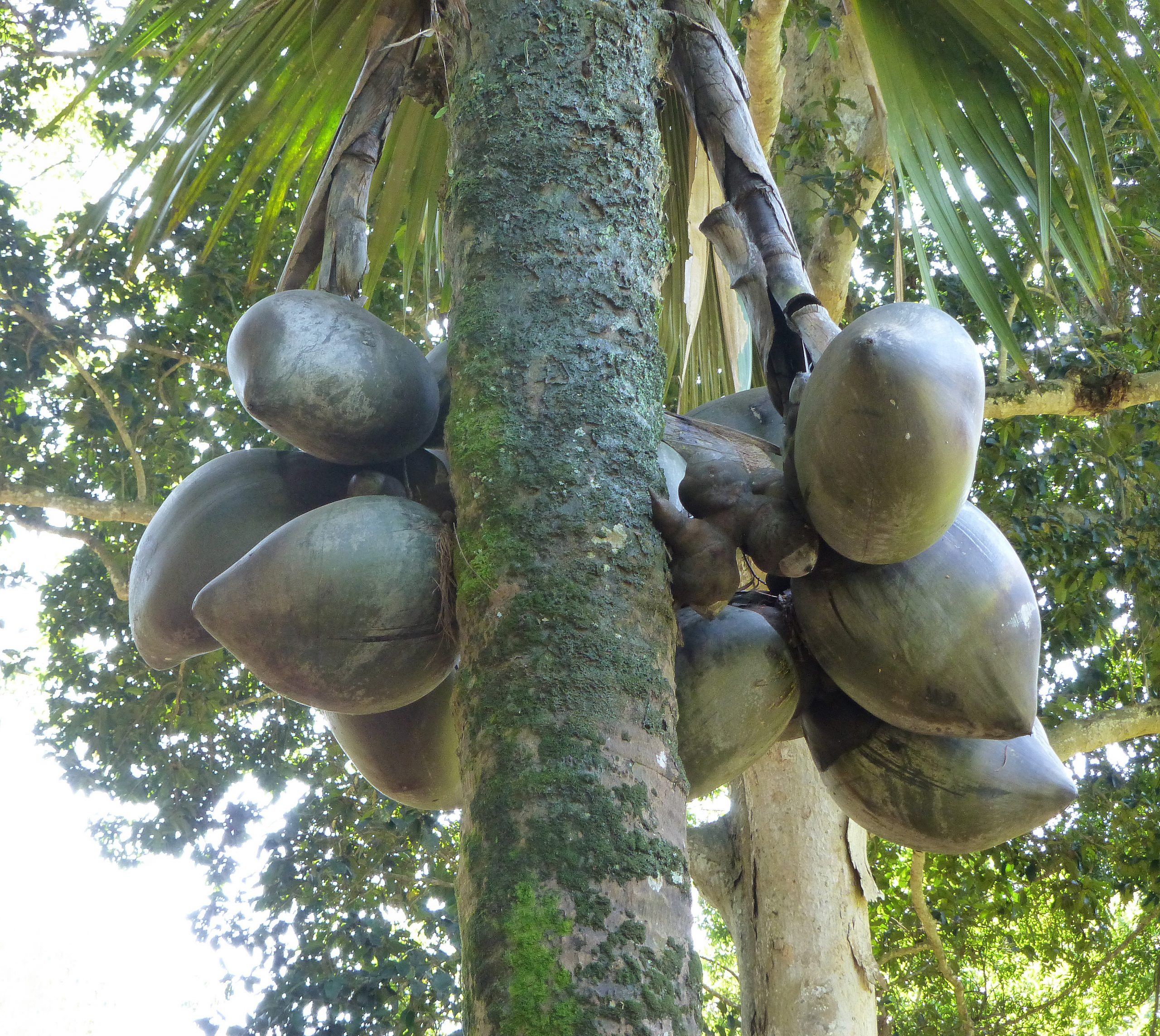
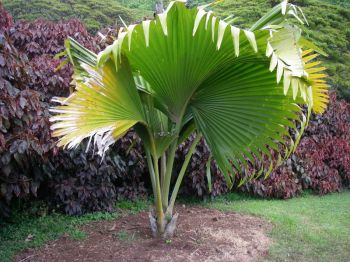
Height to 25–34 m (82–110 feet) tall. Leaves are costapalmate, re-curving (shortened mid-rib), 7–10 m long and 4.5 m wide, with petioles 4 m long. It is dioecious, with separate male and female plants. The female inflorescence (flower stem) is up to 1 meter long, with multiple flowers 4–5 cm (2 inches) wide; male flowers are catkin-like, up to 1 m long. The fruit takes 6–10 years to mature. It is generally two-lobed but may have four or even six lobes. It typically reaches a size of 40–50 cm (16–20 inches) in diameter and weighs 15–30 kg (7–14 pounds); the largest fruit recorded weighed 42 kg (just over 19 pounds). Seeds require 2 years to germinate, and the plant must grow 20–40 years to start flowering. (eol.org) Editing by edric.
This palm has the longest leaves and the largest and heaviest seeds of any plant in the world.
The plant may grow up to 34 metres in height, with leaves up to 10m in length and 4m in width. The male and female flowers are borne on separate trees and the male catkins can reach 1 metre in length, making them the longest in the world. It also has the largest female flowers of any palm species. The seeds can weigh as much as 30 kg. Producing the largest seeds in the plant kingdom (weighing up to 30kg), (although cultivated pumpkins, Cucurbita maxima, with heavier weights have been recorded) this giant of the plant world was known to sailors in the Indian Ocean long before its real home was discovered.
Habit
Lodoicea is robust, solitary, up to 30 m tall with an erect, spineless, stem which is ringed with leaf scars (Calstrom, unpublished). The base of the trunk is of a bulbous form and this bulb fits into a natural bowl, or socket, about 2.5 ft in diameter and 18 inches in depth, narrowing towards the bottom. This bowl is pierced with hundreds of small oval holes about the size of a thimble with hollow tubes corresponding on the outside through which the roots penetrate the ground on all sides, never, however, becoming attached to the bowl; they are partially elastic, affording an almost imperceptible but very necessary “play” to the parent stem when struggling against the force of violent gales.
Leaves
The crown is a rather dense head of foliage with leaves that are stiff, palmate up to 10 m in diameter and petioles of two to four metres in length. The leaf is plicate at the base, cut one third or more into segments 4–10 cm broad with bifid end which are often drooping. A triangular cleft develops at the petiole base. The palm leaves form a huge funnel that intercepts particulate material, especially pollen, which is flushed to the base of the trunk when it rains. In this way, Lodoicea improves its nutrient supply and that of its dispersal-limited offspring.
Flowers
The clusters of staminate flowers are arranged spirally and are flanked by very tough leathery bracts. Each has a small bracteole, three sepals forming a cylindrical tube, and a three-lobed corolla. There are 17 to 22 stamens. The pistillate flowers are solitary and borne at the angles of the rachis and are partially sunken in it in the form of a cup. They are ovoid with three petals as well as three sepals. It has been suggested that they may be pollinated by animals such as the endemic lizards which inhabit the forest where they occur.Pollination by wind and rain are also thought to be important. Only when Lodoicea begins to produce flowers, which can vary from 11 years to 45 or more, is it possible to determine the sex of the plant. The nectar and pollen are also food for several endemic animals e.g. bright green geckos (Phelsuma sp.), white slugs (Vaginula seychellensis) and insects.
Fruit
The fruit is bilobed, flattened, 40 to 50 cm long ovoid and pointed, and contains usually one but occasionally two to four seeds. The epicarp is smooth and the mesocarp is fibrous. The endosperm is thick, relatively hard, hollow and homogenous. The embryo sits in the sinus between the two lobes. During germination a tubular cotyledonary petiole develops that connects the young plant to the seed. The length of the tube is reported to reach about four metres.In the Vallee de Mai the tube may be up to 10 m long.
Lodoicea was once believed to be a sea-bean or drift seed, a seed evolved to be dispersed by the sea. However, it is now known that the viable nut is too dense to float, and only rotted out nuts can be found on the sea surface, explaining why the trees are limited in range to just two islands.
Delivery: With in 3-5 days
Any questions, feel free contact us:
Reviews
There are no reviews yet.