
Description
Dwarf pachypodium, spiny adenium
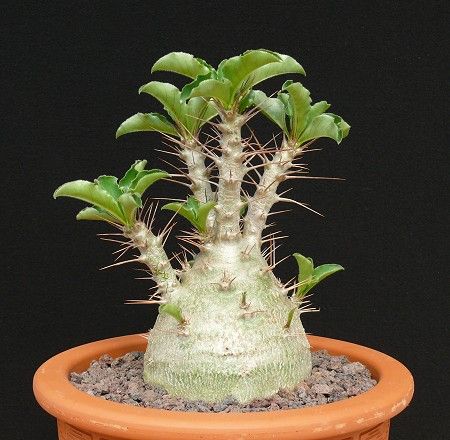
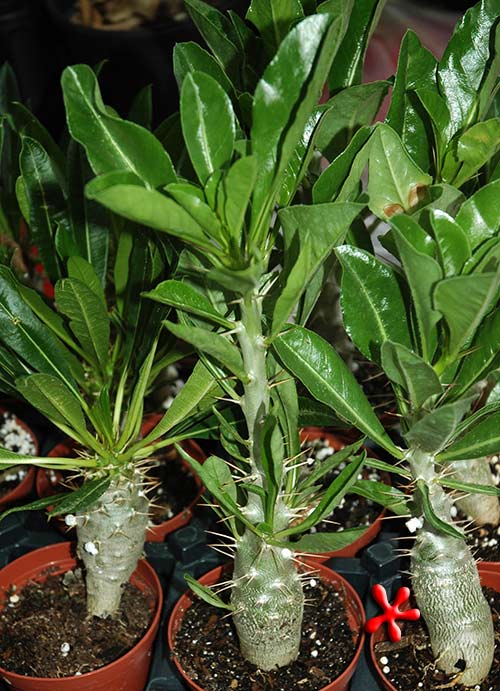
The Bottle tree (Pachypodium lealii Welw.) is a species of plant included in the genus Pachypodium. The scientific name derives from the 19th century Portuguese geologist Fernando da Costa Leal, who described the Bottle tree during an exploration in southern Angola.
This species can be either a shrub or a tree up to 6 meters tall and is characterized by the thick bottle-shaped trunk, which is almost branchless until the top. The branches are few and covered by slender thorns up to 30 cm long. Leaves are oblong and are covered with short hairs on both surfaces. The flowers, shown below in detail, are present in the spring, when the tree is leafless. The white flowers, characteristic of the Apocynaceae family, cluster around the tips of the branches.
The Bottle tree is an endemic species of Namibia and southern Angola where it occupies the semi-desert areas and dry bushvelds, usually along rocky hillsides. It is especially common in the Etendeka plateau of NE Namibia, where it can be seen growing in the basalt slopes.
The plant produces a watery latex, rich in toxic alkaloids, used by local populations as arrow poison for hunting. In contact with the eyes this latex can produce blindness.
Soils have to be very well draining or these plants will rot if kept wet too long in poorly draining soils. There are dozens of excellent soil choices, however, and as long as they contain a lot of porous materials (pumice, perlite or scoria), sand and some organic soil (potting soil, decomposed bark etc.) Pachypodiums seem quite content.
This Pachypodium brevicaule is in pure pumice, for the purpose of rooting, and this is too well a draining soil in the long run… but pumice is an excellent base of any good draining soil
All these plants are demanding of high light situations and suffer in dark, shady locations. Most are full sun plants in the wild. If grown indoors, keep in a southwest facing window ideally (these plants may need to be turned periodically from leaning toward the light and growing crookedly).
Pachypodiums are not very cold tolerant plants. Growing them outdoors in marginal climates like those in southern California can be a risky situation, though some species are much more likely to do well than others. Pachypodium lamerei, geayi, lealii (including sandersii) and succulentum are the most likely species to do well outdoors, with many having success also with namaquanum, densiflora and rutenbergianum as well. Most other species are usually grown in pots as they are either too expensive or too touchy to be reliable outdoor plants in marginally frosty climates. Frosts down to 28F rarely are a problem for most of these cooler-hardy species, but temps down to 26F or below will usually cause severe damage to the trunk/caudex. Last year all most of my outdoor Pachypodium saw 25F-27F and had significant damage to the degree that new growing centers had to start forming at the point of injury. Some proceeded to rot from that point on down. If a Pachypodium gets this sort of frost damage, it is recommended they be removed from the offending climate situations (ie dug up and moved indoors, or move the whole pot indoors if in a pot), preferably in a south-facing warm window for recovery. Apply rooting hormone to the injured area and do not water the plant for a long time. Most will recover and at least one (usually several) new stems will grow from the injured site. Sometimes this is a good thing making the plant more interesting. However it can take years if not forever for the unsightly blemish of the frost-scar to look better.
Pachypodiums exposed to cold: on left is the before and after of a Pachypodium lamerei frozen to the point of rot (top had to be cut off), but then two new heads grew back; Pachypodium geayi with a sudden freeze damaging all the leaves, and then the after shot of the leaves haven fallen off (they all grew back)
Fertilizer is not usually needed if one is going to repot their plants every 2-3 years. But otherwise a gentle liquid fertilizing in summers is probably not a bad idea, and may promote flowering. It is recommended to use a standard fertilizer that has even quantities of all three major nutrients, or perhaps a tad heavy on the phosphorous in summer. Some provide extra potash or potassium in the summer and fall to help improve winter hardiness (a common practice with Plumeria growers) if growing these outdoors in marginal climates.
There is little unique to keeping these species in pots that differ in any way from keeping other succulents in pots, except remember these get tall and the trunks are full of water, which can make them very heavy, which, if not kept in a heavy enough pot, will make them easy to tip over. This is even more important if growing a large crested plant as these become very top heavy.


Reviews
There are no reviews yet.